02 / Research & Projects

Research & Projects

Research and engineering projects spanning neural interfaces, wearable sensing, and physical device design.

Engineering projects

Built, tested, and in progress.

Explore completed projects in device design and neural signal analysis, alongside ongoing work on wearable brain sensing. Each project shows the questions, methods, and current stage of the work.

01 / Liu-CoMotion Lab, UIC

EEG and neurorehabilitation research

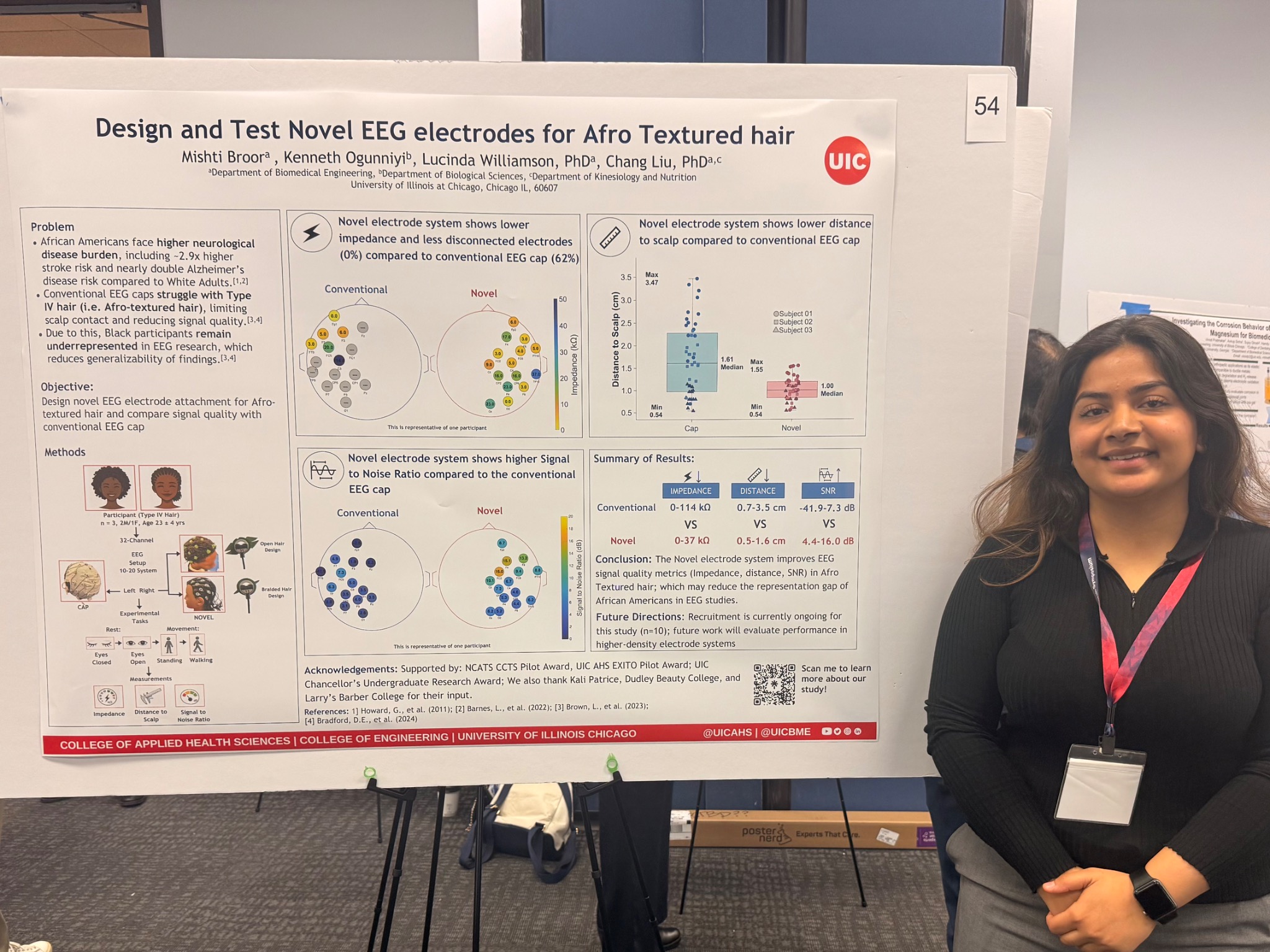
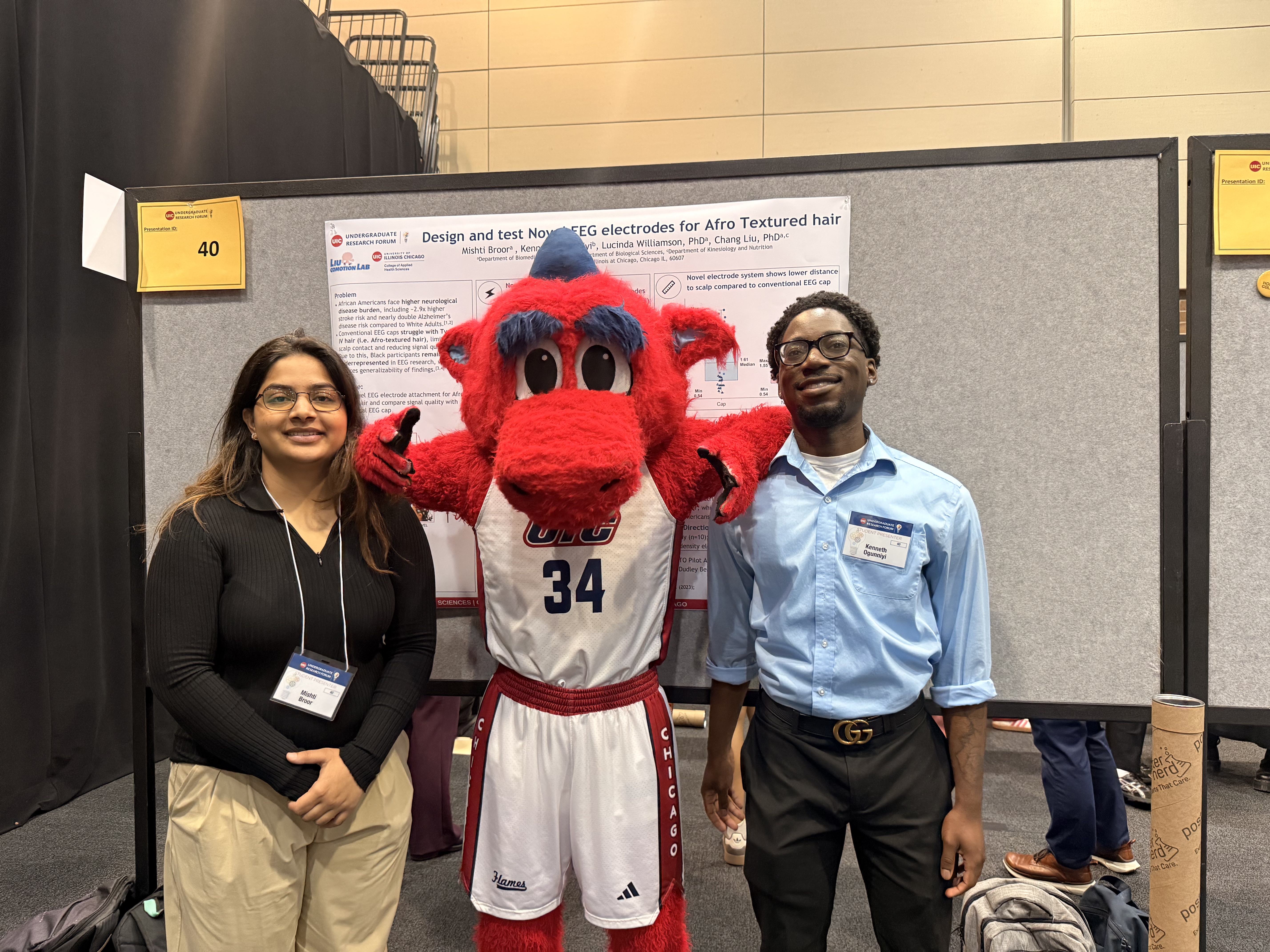
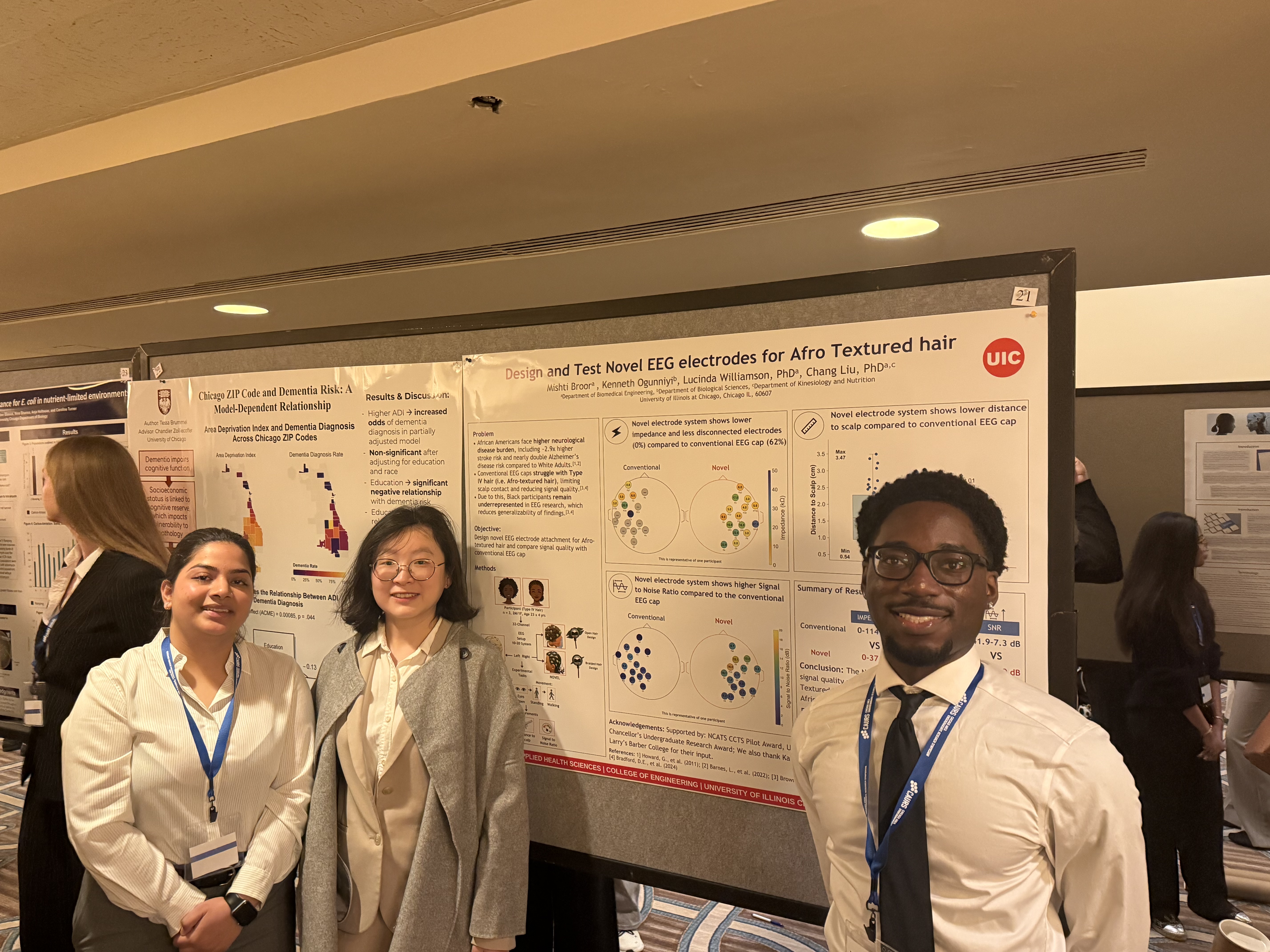
I designed and evaluated electrode attachments for Type IV Afro textured hair, working between CAD, resin 3D printing, human subject testing, and neural signal analysis.

Design

Open Hair and Braided Hair attachment geometries.

Testing

Contact, impedance, disconnections, alpha SNR, and comfort.

Outcome

Fewer electrode disconnections and better contact with comparable resting alpha SNR.

Technical highlights
  • Modeled and resin printed attachments intended to improve scalp contact while accommodating different hairstyles.
  • Worked with 32 channel EEG, IMUs, and instrumented insoles in multimodal gait and mobility studies.
  • Measured scalp contact, impedance, signal quality, and participant comfort.
  • The study poster reported fewer disconnected electrodes and lower impedance. The difference in comfort ratings did not reach statistical significance.

The repository includes MATLAB and Python analysis scripts, plus 3D-printable electrode STL files. Raw human-subject EEG recordings are not included.
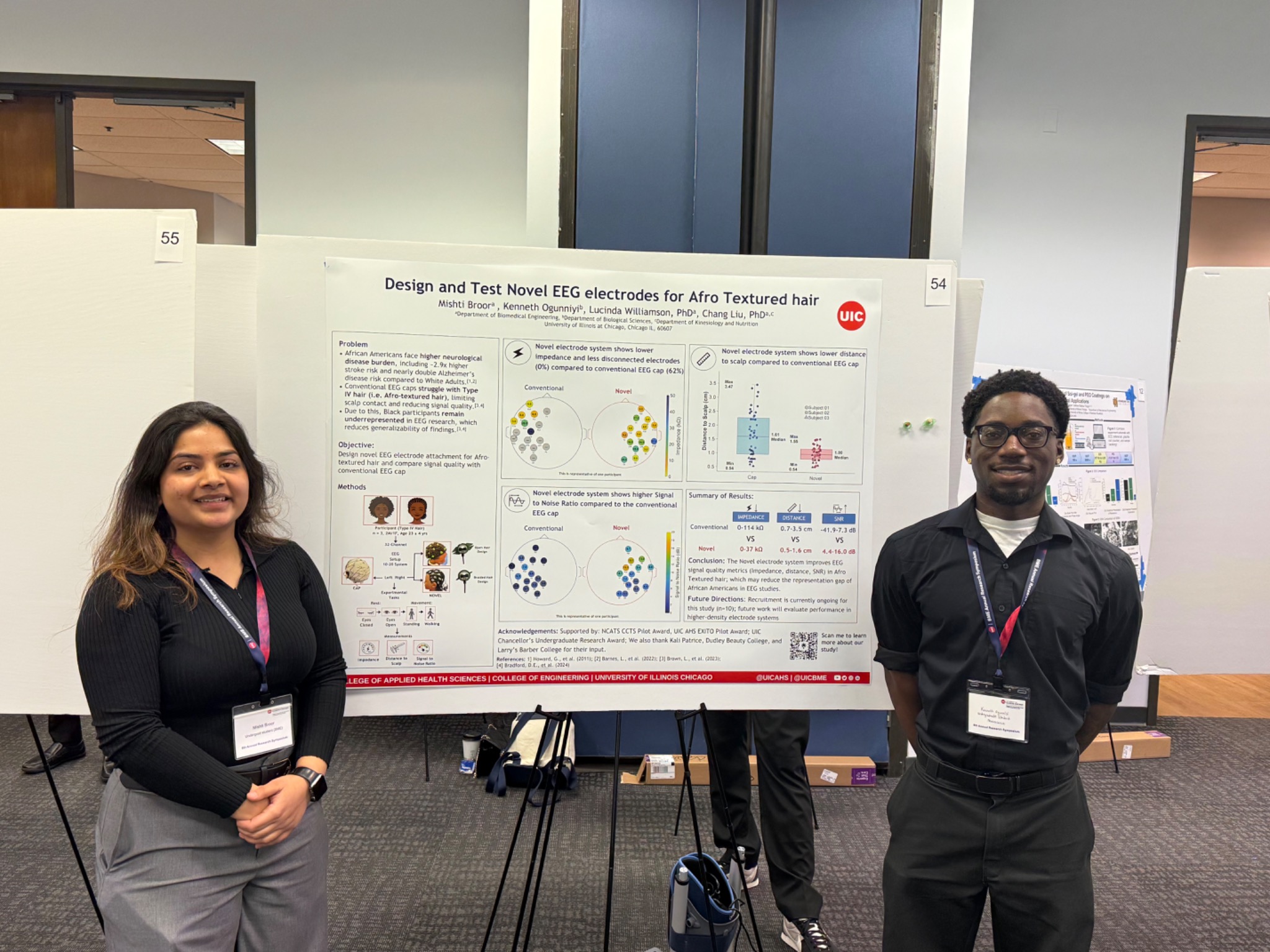
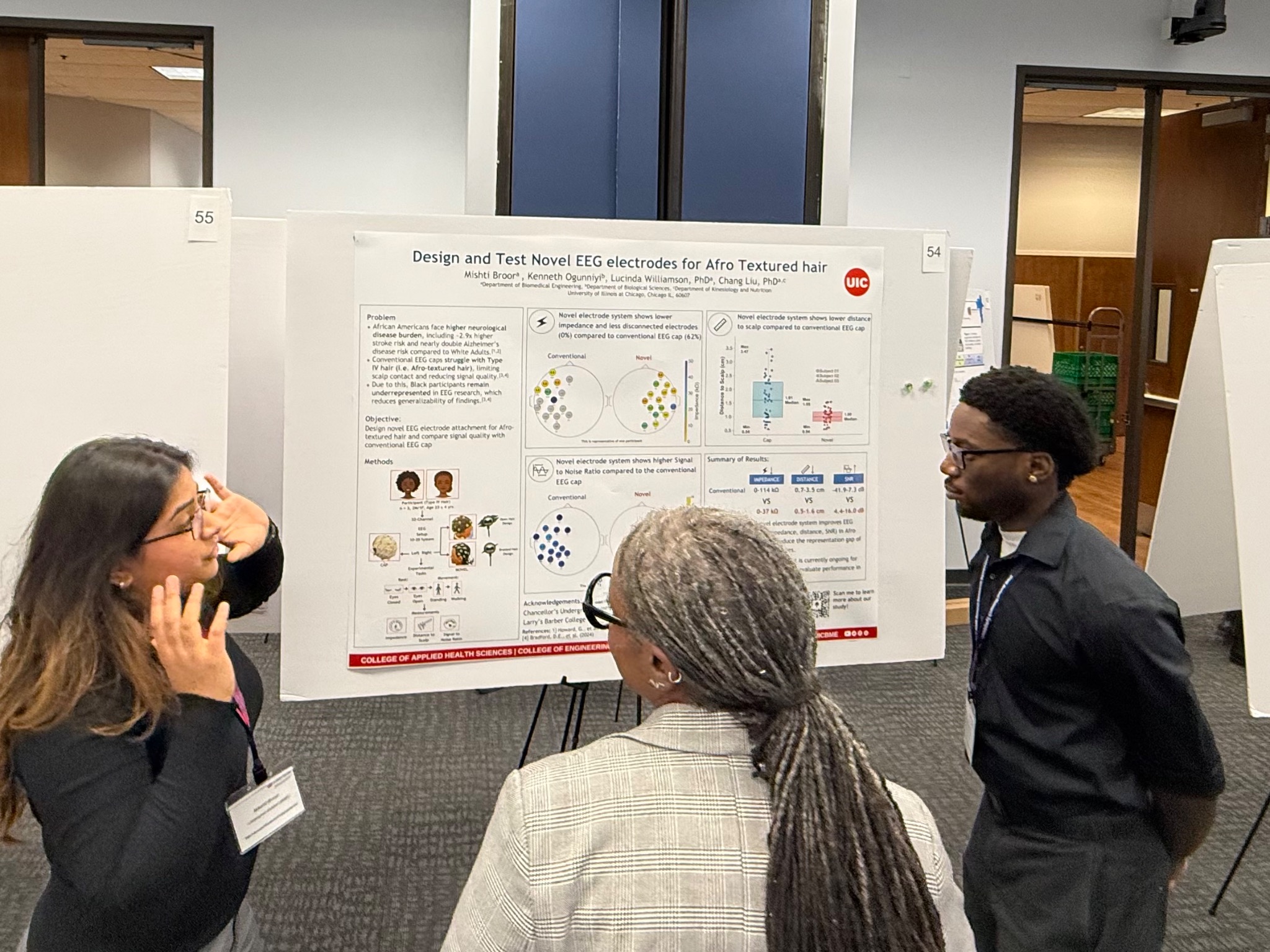
Research presentation with poster
Research poster presentation
EEG research discussion
Discussing EEG electrode designs
Research poster presentation
Presenting research findings

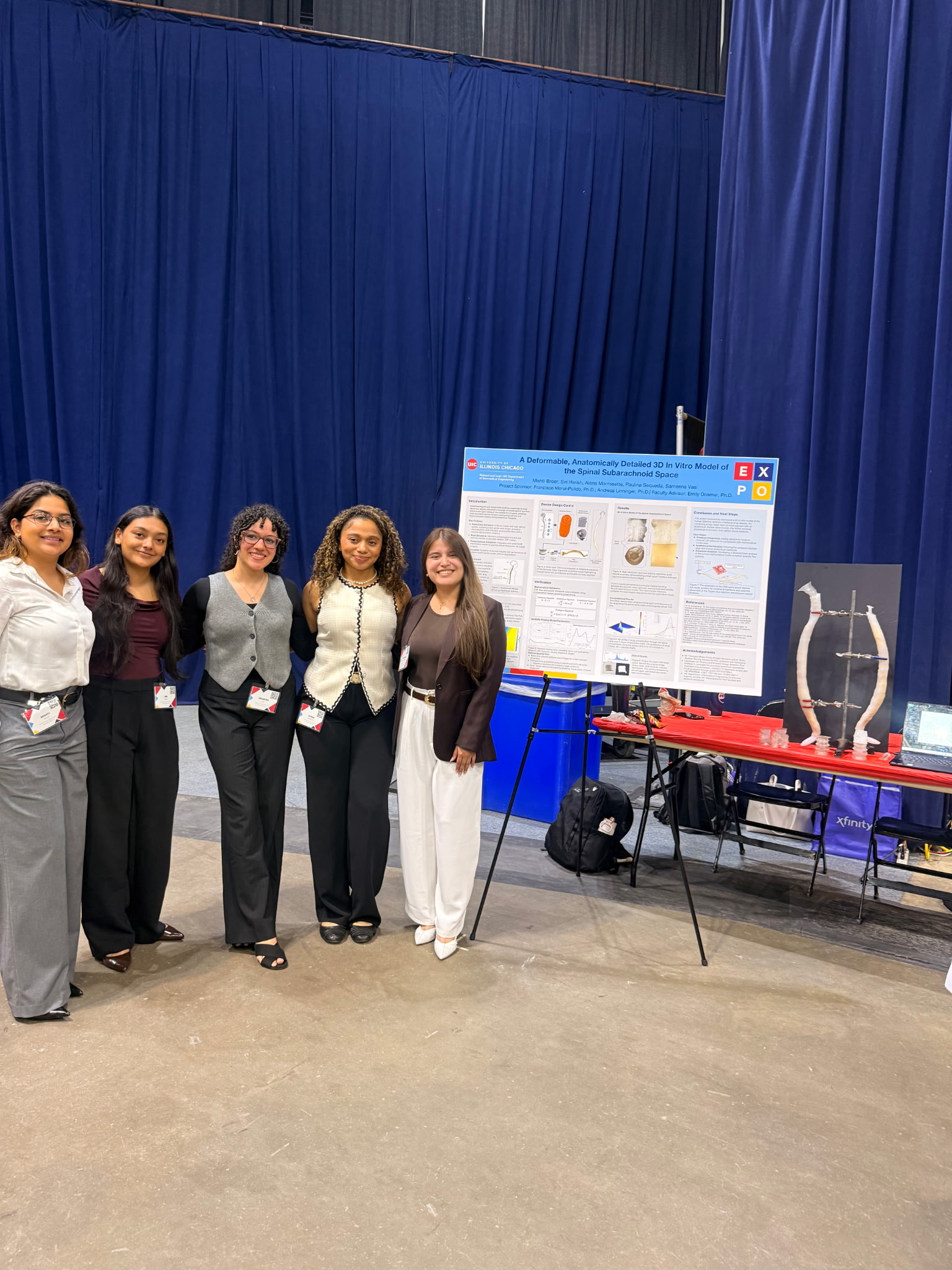
02 / UIC Senior Design

Deformable spinal subarachnoid space model

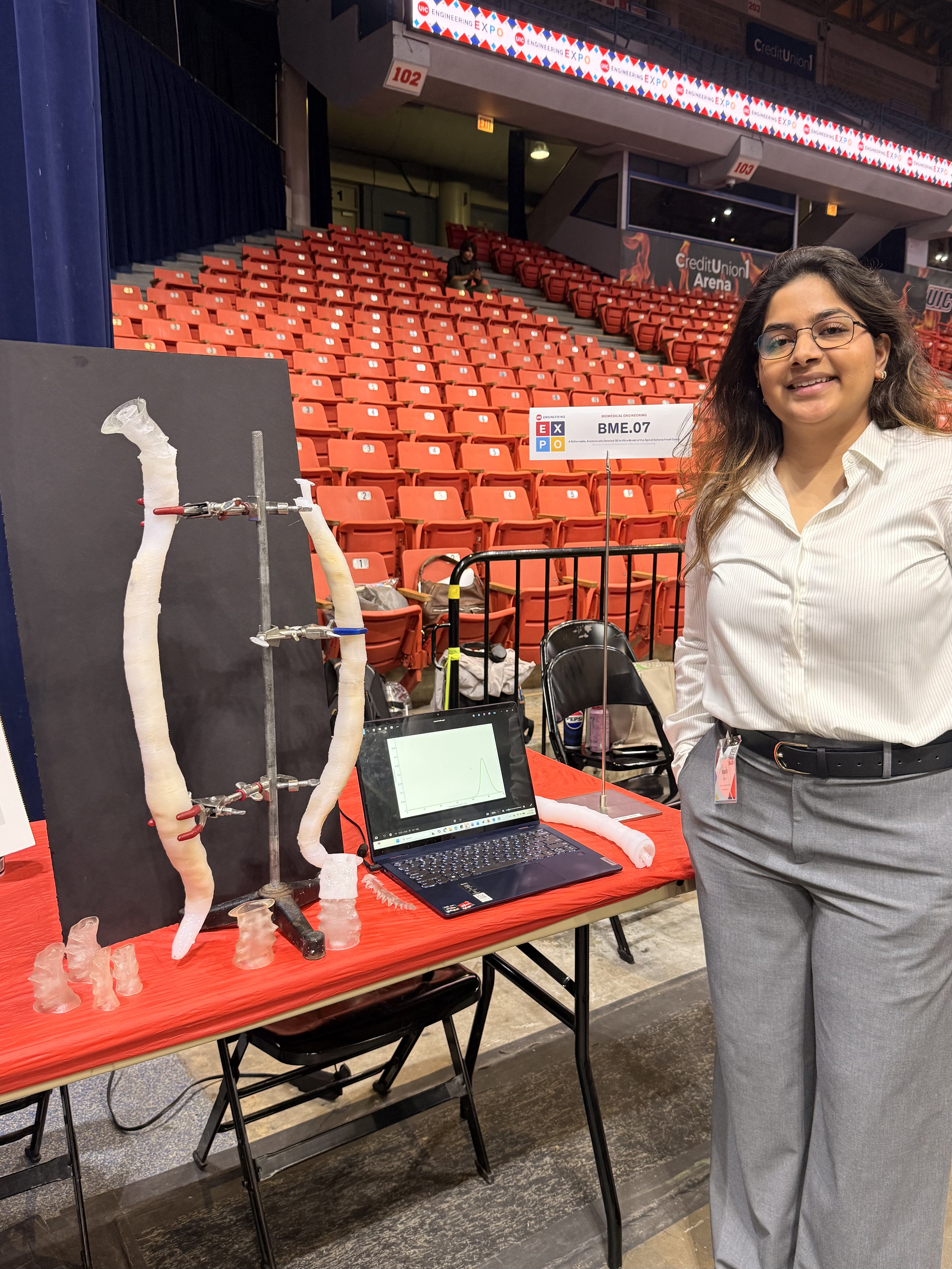
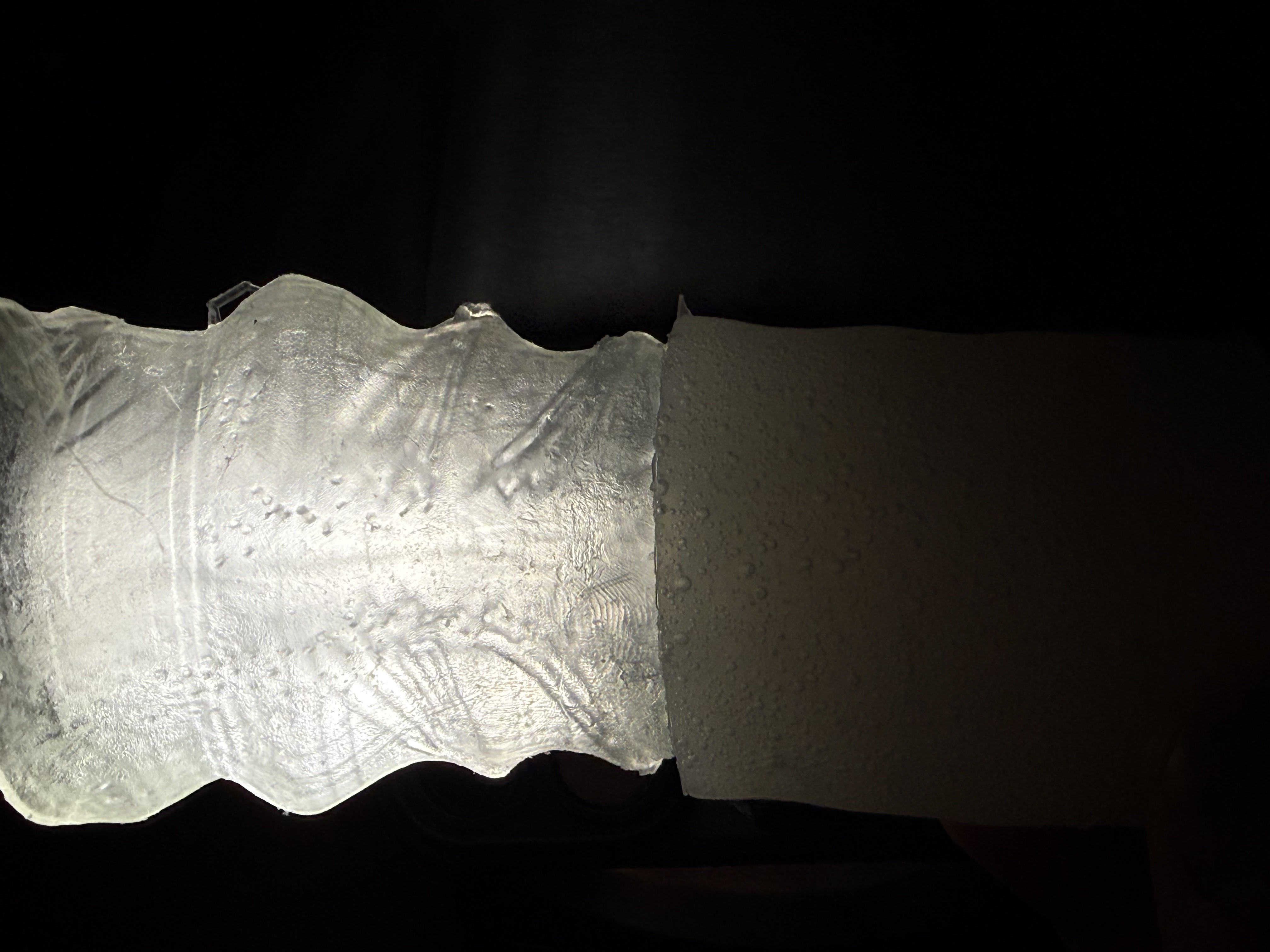
Our team developed an anatomical model to study cerebrospinal fluid transport and support future intrathecal drug delivery research, combining a clear resin segment with a flexible silicone section.

Fabrication

Fusion 360 molds, sacrificial PVA printing, and silicone casting.

Prototype

10 cm hybrid assembly demonstrating a sealed interface.

Analysis

Flow modeling and MATLAB optical measurements.

Technical highlights
  • Created negative molds and used sacrificial PVA to cast a flexible silicone channel.
  • Combined rigid and flexible materials for anatomical visualization and controlled flow experiments.
  • Modeled CSF transport and tracer dispersion and assessed optical transparency.
  • The full 60 cm model and pressure sensing were future development steps, not completed clinical validation.

Senior design team project. First place in Biomedical Engineering and fourth overall at the 2026 UIC Engineering Expo.

03 / Independent ML research

EEG motor imagery classification

I developed a reproducible classifier for imagined left and right hand movement using PhysioNet EEG, then examined why results differed across participants and whether the model relied on motor related activity.

69%

Mean cross validation accuracy for one subject with CSP.

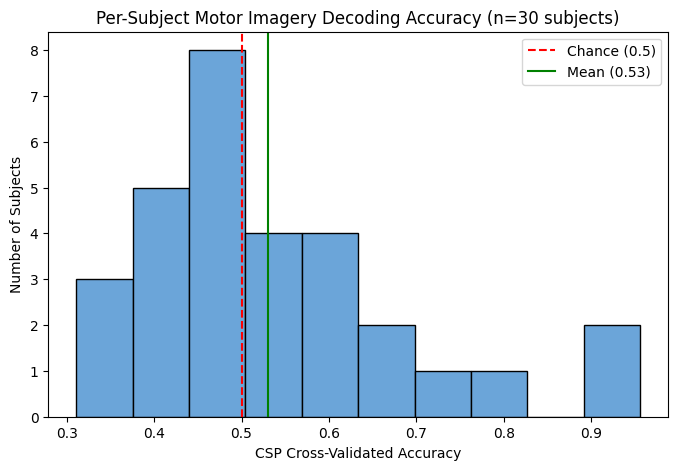
5 of 30

Subjects with nominally significant decoding.

96%

Subject 7 motor-region control, not a group-level result.

Technical highlights
  • Used MNE Python for 8 to 30 Hz filtering and segmentation, and scikit-learn for classification.
  • Compared naive spectral features with Common Spatial Patterns.
  • Across 30 subjects, the mean was 53% and the group-level result was not significant.
  • The motor-channel control supported a sensorimotor contribution, without establishing an exclusive neural source.

Individual and group findings are reported separately to avoid overstating the model's performance.

Code, figures, and methods on GitHub ↗
CSP scalp topography
CSP spatial patterns
Individual EEG decoding accuracy
Accuracy distribution across participants

04 / Northwestern FORGE · Team project Ongoing

Testing brain sensing in smart glasses and earbuds

How much EEG information can we retain when we move from a full electrode cap to the few sensor locations available in wearable form factors? Our FORGE team is developing a benchmarking approach to investigate that tradeoff using existing EEG recordings.

Question

How does reduced electrode coverage affect EEG-based task classification?

Approach

Simulate realistic glasses and ear electrode placements using full-cap datasets.

Status

Research and benchmark planning underway. No final accuracy results yet.

Current work and next steps
  • Researching which EEG tasks and signals are plausible with electrodes around the forehead, temples, and ears.
  • Defining physically realistic sparse electrode layouts that can be compared against full-cap recordings.
  • Reviewing potential public datasets and baseline methods, including PSD features with shrinkage LDA and EEGNet, for a consistent comparison.
  • Planning to visualize how classification performance changes across electrode configurations. No hardware prototype is being built for this project at this stage.

This is ongoing team research. The benchmark, models, and results are not presented as completed.

Benchmark concept / Not a hardware prototype

01 / ReferenceFull-cap EEG datasets

Existing recordings with broad electrode coverage

02 / Simulate sparse layouts
GlassesForehead and temple regions
EarNear-ear electrode regions
03 / CompareClassification performance

Measure the change relative to the full-cap baseline

The diagram represents the planned analysis workflow. It does not show measured performance.

Other engineering projects

Design explorations.

Earlier concept-stage work, distinguished from completed prototypes and clinically validated devices.

01 / Wearable sensing

Wearable sEMG device

Concept for sensing localized muscle activity and exploring myofascial signals.

02 / Medical device concept

Magnetic biopsy capsule

A concept for magnetically guided gastrointestinal tissue sampling.

03 / Biosensing

Tear fluid glucose monitor

A smart contact lens concept exploring noninvasive tear glucose sensing and wireless readout.

Research output

Publications & presentations.

October 2026

EEG electrode attachments for Type 4 Afro-textured hairstyles

Research preprint, bioRxiv.

Read preprint ↗
November 16, 2026

Society for Neuroscience Annual Meeting

Accepted poster on inclusive EEG electrodes · Scheduled presentation